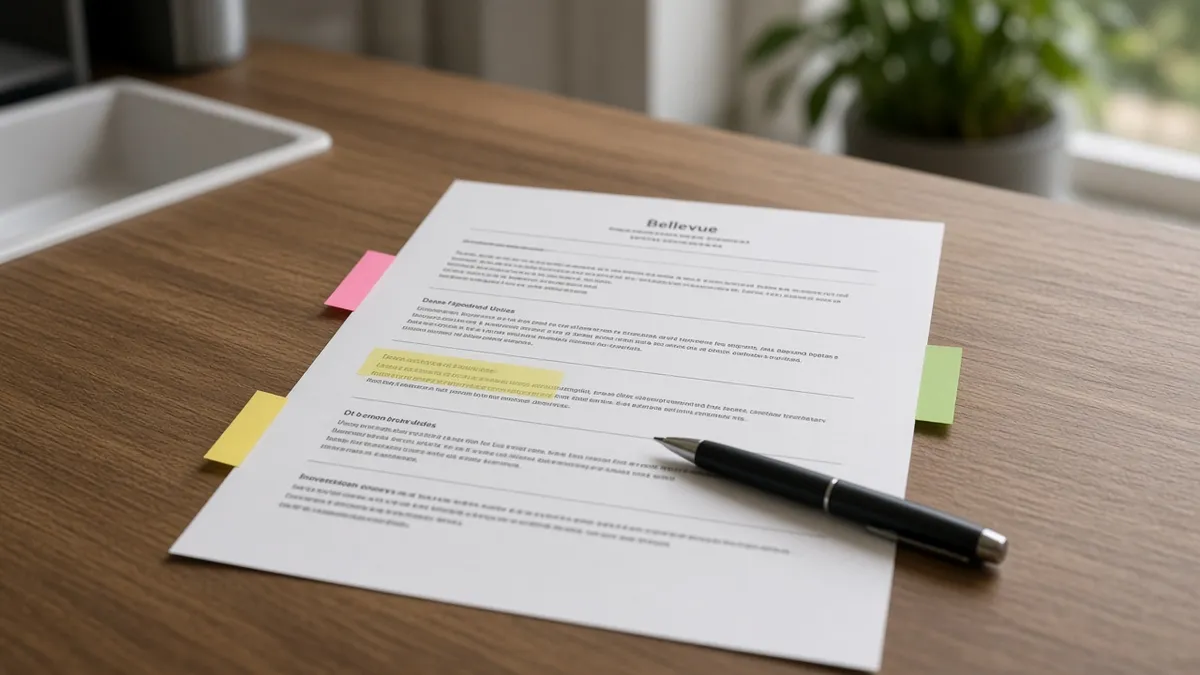
Most remodel disputes start with something nobody wrote down. A finish, a date, a price for extra work.
A clear contract prevents most of them. This kitchen remodel contract checklist shows what yours should cover before you sign.
What should a kitchen remodel contract include?
A kitchen remodel contract should include the full scope, a product list and the price with sales tax. It also needs a payment schedule, dates, a change order process and allowances. Permit duties, lien protections and warranty terms round it out.
Washington L&I lists the basics on its Hire Smart page. They include “Price, including sales tax” and “Payment terms, such as paying as work is completed and completion date.”

Why a written contract matters
A written contract sets what you are buying, what it costs and what happens when plans change. Without one, you have little to stand on in a dispute.
L&I is blunt about it. It advises homeowners to “Avoid verbal contracts or amendments.” It also lists a contractor who “Does not provide a written contract or complete bid” as a red flag.
A good contract protects both sides. The contractor knows what to build. You know what you will get and when.
The kitchen remodel contract checklist
Check each of these 20 items before you sign. If one is missing, ask for it in writing.
| # | Item | What to look for |
|---|---|---|
| 1 | Contractor details | Business name, address, phone and L&I registration number |
| 2 | Your details | Your name and the property address |
| 3 | Scope of work | Every task, room by room |
| 4 | Plans or drawings | Attached and referenced |
| 5 | Product list | Brands, models, colors and sizes |
| 6 | Allowances | Amounts for items not yet chosen |
| 7 | Exclusions | What is not included |
| 8 | Total price | With sales tax stated |
| 9 | Payment schedule | Small deposit, then by phase |
| 10 | Start date | A firm or target date |
| 11 | Completion date | Or a schedule by phase |
| 12 | Permits | Who pulls them and who pays |
| 13 | Inspections | Who schedules and attends |
| 14 | Change orders | Written, priced and signed before work |
| 15 | Hidden conditions | How damage behind walls is handled |
| 16 | Site rules | Work hours, dust control, cleanup |
| 17 | Subcontractors | Which trades are subbed out |
| 18 | Lien releases | From major subs and suppliers |
| 19 | Warranty | What is covered and for how long |
| 20 | Disclosure statement | Received before work begins |
Scope of work and product list
The scope is the heart of the contract. It should be detailed enough that a stranger could read it and know what will be built.
A weak scope says “remodel kitchen.” A strong scope lists each task:
- Remove existing cabinets, counters and flooring
- Install semi-custom cabinets per the attached plan
- Template and install quartz counters with an undermount sink
- Install tile backsplash to the bottom of the upper cabinets
- Install four new recessed lights and under-cabinet lighting
The product list matters just as much. “White cabinets” is not enough. You want the brand, door style, finish and sizes.
Allowances and exclusions
An allowance is a set amount for an item you have not picked yet. An exclusion is anything the contractor will not do.
Allowances are normal. Tile and light fixtures are often picked late. The contract should say what happens if you spend more or less than the allowance.
Exclusions are where surprises hide. Common ones:
- Repairs to damage found behind walls
- Lead or asbestos testing and abatement
- Appliance delivery or haul-away
- Painting outside the kitchen
- Moving furniture
Read the exclusions list twice. Ask what each one would cost if you need it.
Price, sales tax and payments
The contract should show the full price and the sales tax. Payments should follow completed phases.
Washington sales tax applies to the full contract price of a remodel. The Department of Revenue says contractors must state sales tax separately. “Tax included” is not enough. In Bellevue, the combined rate is 10.3% for October through December 2026.
For payments, L&I says: “Besides a reasonable down payment, you should pay your contractor only when specific phases of a project are completed.” It also says to avoid paying in full until all work is complete and you are satisfied.
| Payment stage | Tied to |
|---|---|
| Deposit | Contract signing |
| Progress payment 1 | Demolition and rough-in complete |
| Progress payment 2 | Cabinets installed |
| Progress payment 3 | Counters and finish work complete |
| Final payment | Final inspection passed and punch list done |
This is an example structure, not a legal requirement. For more detail, read our guide on kitchen remodel deposits and payment schedules.
Dates and schedule
Get a start date and a completion date in writing. A phase-by-phase schedule is even better.
Dates should account for cabinet lead times and inspections. Ask what happens if dates slip, and why they might.
Reasonable reasons include late deliveries, failed inspections or hidden damage. “We had another job” is not one.
Change orders
A change order is a written change to the contract. It should list the new work, the price and the schedule impact. Both of you sign it before work begins.
Common change orders in kitchens:
- A different appliance size
- Extra outlets or lighting
- Repairs found during demolition
- A different counter edge or backsplash height
The contract should say how change orders are priced. Some use a fixed price per change. Others use labor plus materials. Either works if it is written down.
Permits and inspections
The contract should say which permits the job needs and that the contractor will pull them.
In Bellevue, replacing cabinets or counters needs no building permit. Moving gas lines, adding circuits, moving plumbing fixtures or changing structure does.
L&I lists a contractor who asks you to get the building permit as a red flag. The registered contractor should pull permits in their own name.
The Disclosure Statement Notice to Customers
Washington contractors must give you a disclosure statement before work starts. It applies to residential jobs of $1,000 or more.
RCW 18.27.114 sets this rule. The notice explains your lien rights. It warns that “your property may be liened to force payment and you could pay twice for the same work.”
The law also has teeth. A contractor who skipped it cannot bring a lien claim unless they prove it was given.
Make sure you receive it and keep a signed copy.
Lien releases
Ask for lien releases from major subcontractors and suppliers as you pay. They protect you from paying twice.
If your contractor does not pay a sub or supplier, they may file a lien on your home. L&I advises you to “request a completed lien release from all major subcontractors and suppliers.”
For a project over $6,000, L&I also says to consider asking for a performance bond. Our guide to construction liens for Washington homeowners explains how liens work.
Site rules and work hours
Write down when the crew works, how they protect your home and how they clean up.
Bellevue’s noise code allows construction sounds from 7:00 a.m. to 6:00 p.m. on weekdays and 9:00 a.m. to 6:00 p.m. on Saturdays. Sundays and legal holidays are not allowed without approval. That comes from Bellevue City Code 9.18.020.
Your contract can set tighter hours if you want. Other site rules to include:
- Dust walls and floor protection outside the kitchen
- Where tools and materials are stored
- Which bathroom the crew may use
- Where the dumpster or debris goes
- Daily cleanup at the end of each workday
Warranty and closeout
The contract should state what the warranty covers, for how long and how to make a claim.
Ask for these at closeout:
- A final walkthrough and a written punch list
- Copies of passed inspections
- Manuals and warranties for appliances and fixtures
- Final lien releases
- A written workmanship warranty
Common contract mistakes to avoid
Most contract problems come from vague scope, missing exclusions or verbal changes.
What to avoid:
- Signing a one-page bid as the contract
- Accepting “per discussion” instead of a written scope
- Agreeing to changes by text or phone only
- Paying a large deposit before a full contract exists
- Skipping the exclusions list
Keep a copy of everything
Store the signed contract, change orders, invoices, lien releases and inspection records in one folder. You will need them for warranty claims and when you sell.
How our contracts work
Bellevue Kitchen Pros plans and builds kitchens from start to finish. Because one team handles design and construction, the plan and the contract match.
Your contract includes the full scope, a product list and the price with tax. Payments follow finished phases. Change orders are written and priced before any work.
Learn more about how we handle kitchen remodeling in Bellevue.
FAQs
What is a Disclosure Statement Notice to Customers?
It is a notice Washington contractors must give before starting residential work of $1,000 or more. It explains that your property may be liened if subs or suppliers go unpaid. A contractor who skipped it cannot bring a lien claim unless they prove they gave it. Keep a signed copy.
Should a kitchen remodel contract include sales tax?
Yes. Washington sales tax applies to the full contract price of a remodel. L&I lists “Price, including sales tax” as a contract basic. The Department of Revenue says tax must be stated separately. In Bellevue, the combined rate is 10.3% for October through December 2026.
What is a change order in a remodel contract?
A change order is a written change to the signed contract. It should describe the new or removed work, the price and the schedule impact. Both you and the contractor should sign it before work begins. L&I advises avoiding verbal contracts or amendments, so keep every change on paper.
Can a contractor start work without a written contract?
They can, but you should not let them. Without a written contract, you have little proof of what was promised. L&I lists a missing written contract or incomplete bid as a red flag. Get the full contract and disclosure statement first.
Should a lawyer review my kitchen remodel contract?
For a large remodel, a short review by a construction lawyer can be worth it. It helps most when the contract is long, the price is high or terms feel one-sided. At minimum, read every page and compare it to this checklist. Ask about anything unclear before you sign.
Sign only what you understand
A full kitchen remodel contract checklist covers scope, price with tax, payments and dates. It also covers changes, permits, liens and warranty. If anything is vague, ask for it in writing before you sign.
Book a consultation. We will walk you through every line of a contract for your Bellevue kitchen.
Leave a Reply